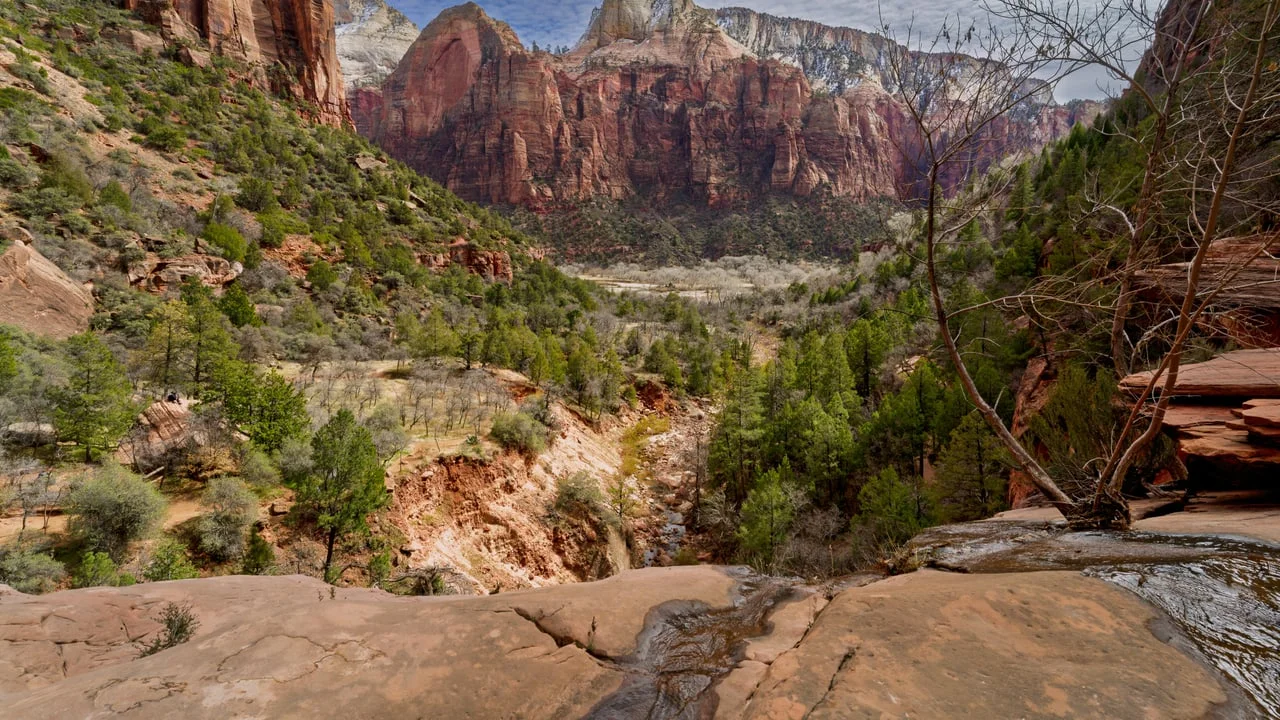
Angels Landing — Zion's Most Iconic Scramble
This week's trail pick: Angels Landing in Zion National Park, Utah. A 5-mile round trip with 1,488 ft of elevation gain, a permit-only chain-assisted summit scramble, and one of the most dramatic views in North America. Full guide covering distance, difficulty, permit lottery, parking, campgrounds, and signature photo spots.

There's a half-mile ridge in southern Utah where the trail stops looking like a trail and starts looking like a challenge. The final stretch to Angels Landing runs along a narrow spine of sandstone — the Hogsback — with iron chains bolted into the rock as your only handhold and 1,000-foot drops on either side. Plenty of hikers turn around at Scout Lookout and still leave with one of the best views they've ever seen. The ones who keep going come back changed.
This week's pick: Angels Landing, Zion National Park, Utah.
At a Glance
| Stat | Detail |
|---|---|
| Distance | 5 miles round trip |
| Elevation Gain | 1,488 ft (453 m) |
| Difficulty | Strenuous — chains required on final 0.5 mi |
| Est. Time | 4–5 hours |
| Trail Type | Out-and-back |
| Trailhead | Grotto Trailhead, Zion Canyon |
| Permit Required | Yes — lottery via Recreation.gov |
| Best Seasons | Spring (Mar–May) · Fall (Sep–Nov) |
The Route
The trailhead sits at the Grotto Picnic Area in Zion Canyon, accessed only by the free Zion Canyon Shuttle (private vehicles are not permitted in the canyon during peak season). The first mile follows the West Rim Trail through the canyon bottom — flat, wide, easy — before the climb begins.
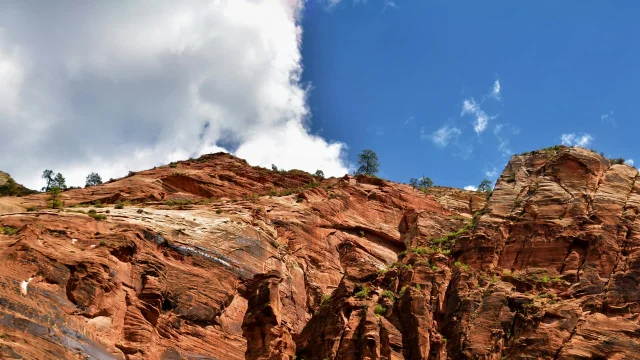
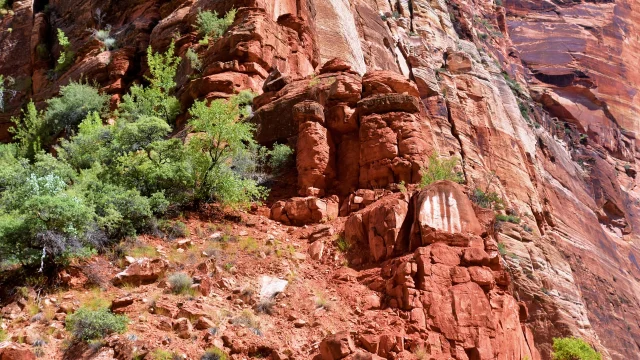
Refrigerator Canyon comes first: a cool, shaded slot wedged between towering walls. Even on a 95°F July day, the temperature in here drops noticeably, and the contrast of red rock and cottonwood green makes it one of the trail's quiet highlights.
Then come Walter's Wiggles — 21 tight, paved switchbacks that gain elevation fast. They look brutal from below and feel almost mechanical to climb, like a staircase someone forgot to flatten. In 15 minutes you're at Scout Lookout, where restrooms sit and where most families make their honest decision about what comes next.
The final half-mile along the Hogsback ridge is what everybody comes for. You clip your hands around cold chain links, lean into the rock, and place each foot deliberately. The drop on both sides is real, the exposure is real, and so is the pull to keep moving. At the summit (5,790 ft), Zion Canyon stretches 1,500 feet below in both directions — the Virgin River a green ribbon between rust-red walls.
Permit & Reservation
Angels Landing requires a permit — no walk-ups. Two ways to get one 2:
Seasonal Lottery — Apply in the 20-day window before each season opens:
- Spring hikes (Mar 1–May 31): apply Jan 1–20
- Summer hikes (Jun 1–Aug 31): apply Apr 1–20
- Fall hikes (Sep 1–Nov 30): apply Jul 1–20
- Winter hikes (Dec 1–Feb 28): apply Oct 1–20
Day-Before Lottery — Enter between midnight and 3 p.m. the day before your intended hike. Results emailed by 4 p.m. Good option if your schedule is flexible.
Permits cover up to six people. Apply at recreation.gov.
Getting There & Parking
Do not drive to the Grotto. Private vehicles are prohibited in Zion Canyon during operating hours. Here's the flow:
- Park at the Zion Canyon Visitor Center (free) or at overflow lots just outside the South Entrance in Springdale
- Board the free Zion Canyon Shuttle at the Visitor Center
- Ride to Stop 6: The Grotto — this is your trailhead
Shuttle buses run every 6–7 minutes during peak hours. Arrive early (before 8 a.m.) on busy weekend days to avoid long shuttle queues.
Entry fee: $35 per private vehicle (valid 7 days). The America the Beautiful Annual Pass ($80) covers entry and is worth it if you're hitting more than two parks this year 3.
Camping Inside the Park
Both in-park campgrounds sit near the South Entrance — within shuttle distance of the canyon 4:
Watchman Campground (year-round)
- 63 RV sites with electric hookups: $30/night
- 66 tent sites: $20/night
- Group sites: $50–$130/night (7–40 people)
- Reservable Mar–Oct at recreation.gov (book early — fills months ahead)
South Campground (February–November)
- 117 tent/RV sites (no hookups): $20/night
- Reservable up to 2 weeks in advance
- Dump station with potable water available
Both campgrounds place you 10–15 minutes by shuttle from the canyon trailheads.
Signature Shots
The standard Angels Landing photos show the Hogsback chains — and they're worth getting — but the real photography opportunities are spread across the whole route:
- Refrigerator Canyon: Shoot upward from the slot toward a narrow strip of blue sky between orange walls. Early morning gives side-lit texture on the rock face.
- Walter's Wiggles from below: The 21 switchbacks form perfect geometric zigzags. Frame them from the base of the climb with a wide lens.
- Scout Lookout panorama: At roughly 5,400 ft, the view east toward Cable Mountain fills the frame. Soft golden-hour light in late afternoon.
- Hogsback ridge looking back: Turn around mid-chain section and shoot back toward Scout Lookout — the ridgeline narrows to a point, and the canyon opens dramatically on both sides.
- Summit 360°: The view from the top encompasses the full sweep of Zion Canyon — the Virgin River corridor, the Great White Throne, and the West Temple. Plan for late morning or afternoon when the canyon shadows have shortened.
Practical Notes
Season: Spring and fall are ideal. Summer temperatures frequently exceed 100°F, and afternoon thunderstorms in July–August can make the Hogsback chains dangerous (lightning exposure is real on that ridgeline). Winter is hikeable but chains become icy — microspikes strongly recommended.
Footwear: Grippy trail shoes or low-cut hiking boots with sticky rubber soles. The sandstone has good friction when dry; smooth-soled sneakers become treacherous on the chains.
Water: Carry at least 2–3 liters per person. Drinking water is available at the Grotto trailhead and at Scout Lookout (restrooms only at Scout Lookout, no fill station).
Children: The NPS recommends this trail is not suitable for young children. The chain section requires confident footwork and comfort with significant exposure.
Turnaround option: Scout Lookout (mile 2.2) is a fully satisfying destination in its own right. The view is extraordinary, and many experienced hikers choose this as their endpoint when conditions on the Hogsback are poor.
Next Saturday: another North American trail worth lacing up for.
이 콘텐츠를 둘러싼 관점이나 맥락을 계속 보강해 보세요.